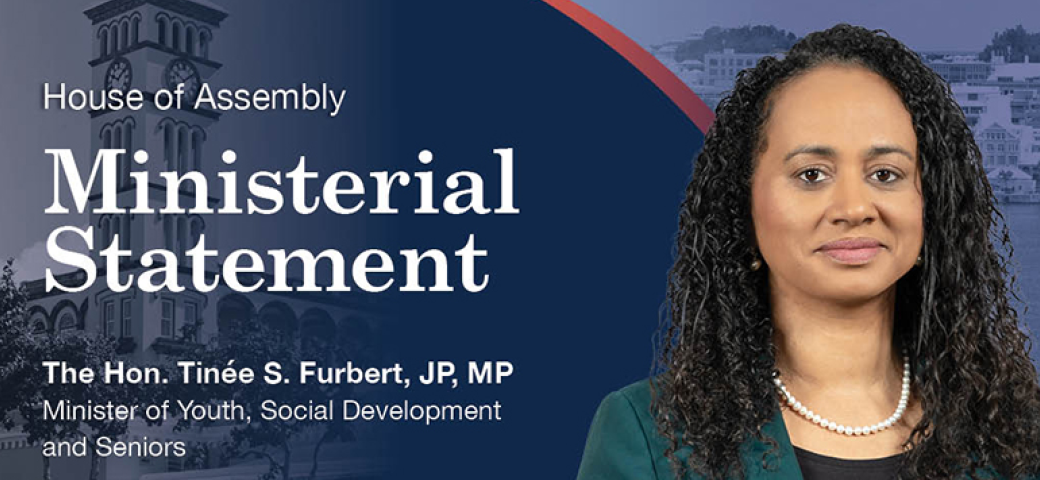
Mr. Speaker, I am pleased today to submit to this Honourable House the Annual Report of the Human Rights Commission for the year ending 31st December 2025.
Mr. Speaker, the Commission has a statutory remit to protect and promote human rights under the Human Rights Act 1981. The Commission's mandate involves education, the promotion of principles of equality and non-discrimination, the investigation of alleged contraventions of the Act, and the resolution of complaints of discrimination.
Mr. Speaker, as Bermuda's National Human Rights Institution, the Commission plays an important role in protecting and promoting human rights while supporting the effective implementation of international human rights standards. Guided by the United Nations Paris Principles, the Commission carries out its work through complaint handling, education, outreach, advocacy, policy engagement, and advice to the Government and stakeholders.
Mr. Speaker, the Commission serves both as a complaints-handling authority and as a public resource. Through its Officers, the Commission provides guidance to individuals, employers, service providers, landlords, educational institutions, community organisations, and the Government regarding rights and obligations under Bermuda's human rights framework.
The Commission furthers its objectives by:
- Receiving and assessing complaints of discrimination;
- Investigating alleged contraventions of the Human Rights Act;
- Providing voluntary mediation services;
- Referring appropriate matters to the Human Rights Tribunal;
- Conducting education and outreach initiatives;
- Participating in policy reviews and consultations;
- Providing guidance to support compliance with human rights obligations; and
- Promoting understanding of human rights across Bermuda.
Mr. Speaker, included in the Annual Report you will note that during the 2025 calendar year:
The Commission received 215 intakes, consisting of complaints, queries, and special programme applications, representing a significant increase from the previous reporting year. Of these, 96 were complaints, 118 were queries, and one was a Special Programme application.
The most commonly identified protected grounds were sex at 19%, disability at 18%, and ethnic or national origins at 14%. These figures continue to highlight the areas where members of our community most frequently experience concerns about unequal treatment.
Within the protected areas of discrimination identified by complainants, employment-related discrimination accounted for 31% of reported concerns, followed by discrimination relating to goods, facilities and services at 17%, and workplace harassment at 13%. Overall, seventy percent of intakes concerned employment and workplace-related matters.
The Commission conducted 24 investigations during the reporting period and referred nine matters to the Human Rights Tribunal, demonstrating a continued increase in matters progressing through the Commission's formal complaint-handling process.
Mr. Speaker, a major milestone during the reporting year was the publication of the report entitled Disability Inclusion in Bermuda: Findings & Recommendations from a National Consultation. This report was informed by extensive consultation with more than 300 residents and was grounded in the principle of "Nothing About Us, Without Us." The report provides a framework of recommendations to advance disability inclusion in Bermuda and to support implementation of Bermuda's obligations under the United Nations Convention on the Rights of Persons with Disabilities.
The consultation revealed that nearly one in two respondents with disabilities reported experiencing discrimination or harassment and highlighted the need for stronger accessibility, accountability, representation, and coordinated national action.
Mr. Speaker, the Commission also strengthened its public education and outreach efforts during 2025, delivering 71 education, outreach and advocacy activities, including presentations, consultations, workshops, community discussions, and public awareness initiatives. The Commission continued to collaborate with a wide range of organisations, including Ageing and Disability Services, Bermuda Is Love, Beyond Inclusion, Vision Bermuda, the Bermuda National Library, Imagine Bermuda, OUTBermuda, and many other community partners.
The Commission further expanded its public engagement through the formal integration of social media into its communications strategy. Between March and December 2025, the Commission's digital platforms generated more than 194,000 views, reached over 51,600 individuals, and recorded approximately 5,400 interactions, helping to make information on human rights more accessible to the public.
Mr. Speaker, the Commission also represented Bermuda internationally through participation in the Caribbean Disability Network Conference in Barbados under the theme "Breaking Barriers: Advancing Inclusive Education for All Abilities." This engagement strengthened regional collaboration and allowed Bermuda to share lessons learned from its Disability Inclusion Report while contributing to broader discussions on accessibility and disability rights throughout the Caribbean.
The Commission continued its advisory role to Government and stakeholders, participating in approximately twenty policy reviews and consultations on matters including constitutional reform, disability rights, age discrimination, pay transparency, HIV criminalisation, and human rights protections.
Mr. Speaker, in closing, I wish to take this opportunity to thank the Human Rights Commission for its dedication to the advancement of human rights in Bermuda and for stewarding the Commission’s mandate with integrity and excellence.
In accordance with Section 30A of the Human Rights Act 1981, I am pleased to have laid before this Honourable House the Human Rights Commission Annual Report for the year ending 31st December 2025.
Thank you, Mr. Speaker.