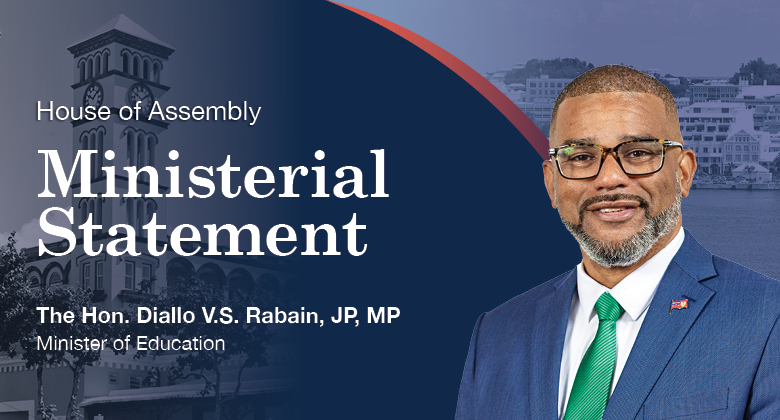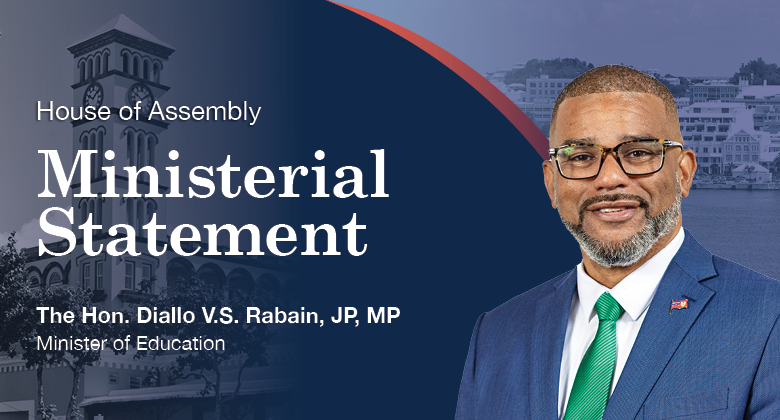
Mr Speaker, I rise today, having recently returned to the office of Minister of Education, to inform this Honourable House that the Ministry of Education has officially released this report today - the Cambridge Checkpoint Report for Bermuda, 2023–2025, prepared by Cambridge International Education. The full report is now available on the Ministry of Education website at www.moed.bm.
Mr Speaker, this report was the subject of a formal request under the Public
Access to Information Act 2010. Consistent with this Government's commitment to transparency, and with my own commitment on returning to this portfolio, I have requested that the report be released today in full to the public, accompanied by a plain-language guide for.
Mr Speaker, the Cambridge Checkpoint assessments are internationally benchmarked diagnostic tools that measure student attainment in English, Mathematics, and Science against clearly defined global standards. Cambridge International Education itself has told us, and I quote, that these assessments are best used "...to focus supportive activity and resources on specific areas of improvement rather than for the purposes of accountability, for which the tests and testing schedules are not designed or best suited...". That is an important
framing, Mr Speaker, because the value of this report lies not in judgement, but in direction.
Mr Speaker, let me first speak to what is going well. Overall student attainment has remained broadly stable over the three-year reporting period, with a consistent proportion of our students achieving in the highest performance bands, categorised as "High" and "Outstanding."
English continues to stand out as a strong area of performance across both
Primary and Lower Secondary levels. Over 65 per cent of our Lower Secondary English students, and over 50 per cent of our Primary English students, have performed at strong bands consistently across the three years covered by this report. Students are demonstrating solid literacy foundations, especially in reading, which remains a key pillar of academic success. This reflects the sustained efforts of our teachers, school leaders, and support staff, as well as the important role of families who read with their children at home.
Mr Speaker, I will also speak plainly about where further work is required. While overall attainment has been maintained, the report identifies a gradual decline in average scores in some subject areas, alongside a widening gap between high-performing students and those requiring additional support. This widening distribution is most evident in Mathematics and Science, where a growing
proportion of students are performing in the lower bands, alongside a reduction of those achieving at mid-level.
In Mathematics, performance remains uneven across strands, indicating the need for more targeted instructional approaches. In Science, outcomes are mixed: Lower Secondary performance remains broadly balanced, while Primary Science, particularly Chemistry, requires more focused attention. Writing in English, while supported by strong reading foundations, requires strengthening across the system.
Importantly, the data confirms that some performance gaps persist year-on-year, regardless of the cohort. This tells us that these challenges require a system-wide response, not individual scapegoating. And that is precisely how this Ministry will address them.
Mr Speaker, I want to speak clearly and directly to our teachers, our principals, and all school-based staff who serve our students every day: this report is not a judgement of you. Cambridge International Education itself has told us these assessments are diagnostic tools, designed to identify where students need support, not to judge individual educators or rank individual schools.
But let me be equally clear, Mr Speaker, the fact that Cambridge is diagnostic does not mean that accountability is absent. Accountability in our public education system rests where it properly belongs, with the Ministry, with the Department of Education, and ultimately with the Minister who stands before this House today. Progress and improvement are expected. Measurable outcomes are expected. And this Ministry accepts that expectation without qualification.
To parents listening today: if you have concerns about your own child's progress, please speak with your child's teacher or principal. A plain-language, parent-
friendly guide is being formatted to accompany this report, helping every family understand these findings and how they can support their child at home. Parents remain our most important partners in this work.
Mr Speaker, I do not stand here today to point fingers. I stand here to point forward. The responsibility for improving outcomes belongs to all of us, the
government, educators, families, and the community, and this Ministry accepts its share of that responsibility fully.
A clear programme of targeted action is underway:
Strengthening Mathematics instruction through focused instructional
strategies and professional development to support teachers in addressing identified learning gaps;
- Expanding writing across the curriculum, so that students write more, more often, and receive clear feedback in every subject;
- Enhancing Science teaching and learning, with particular emphasis on Primary Science, especially Chemistry;
- Enhanced analysis of subject- and strand-level performance data to inform classroom practice, targeted especially at students in the lower
performance bands;
- Strengthening the Multi-Tiered System of Support, so that struggling learners are identified earlier and supported sooner;
- Data-driven School Improvement Plans in every school, aligned with system-wide literacy and numeracy targets;
- Leadership stability - continuing to ensure that every primary and middle school in the Bermuda Public School System is led by a substantively appointed principal, ending a prolonged period of acting appointments;
- Structured, ongoing consultation with the Bermuda Union of Teachers and the BPSU (School Principals) on every element of the response. Reform
delivered on teachers is not reform. Reform delivered with teachers is;
- Continued use of Checkpoint assessment data as a diagnostic tool to drive ongoing school improvement.
Mr Speaker, I will report back to this Honourable House on the specific interventions announced today, with measurable outcomes, within twelve
months. That is my commitment to this House, to our teachers, to our parents, and above all to our students.
Mr Speaker, I close with this. We do not have a broken system. We have a system with real strengths, identified challenges, dedicated educators, engaged families, and children who deserve every ounce of our commitment. That is not
brokenness. That is the honest starting point of the work ahead.
Our children can read. Our educators are working hard. Our system has real
strengths. But too many children are struggling in Mathematics and Writing, and we will not accept that. That is why we are releasing this report today, and that is why we are acting on it.
Thank you, Mr Speaker.